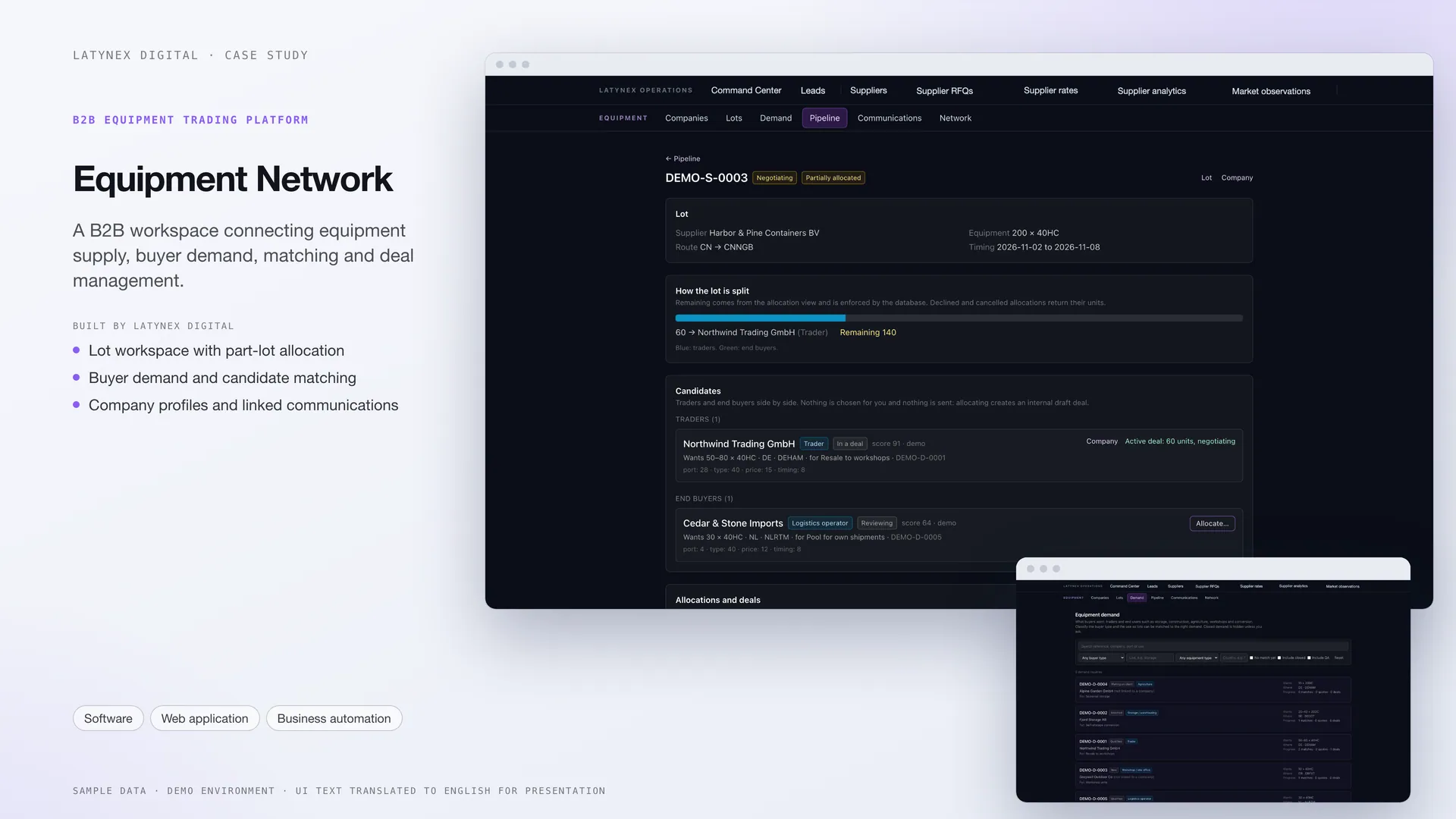
Equipment trading mixes supply from owners, demand from traders and end buyers, partial allocations and many conversations. Spreadsheets and inboxes could not show what was available, who wanted it and what had been promised.
Solution
What LATYNEX Digital built
A dedicated workspace that models lots, demand, matches, allocations and deals explicitly, with a database-level oversell guard, confidentiality rules between internal and buyer-facing views, and communications linked to companies.
What it demonstrates
What this shows we can build
Supply, demand, matching and deal stages in one private workspace, with company contacts and communications linked to each record.
Business rules enforced by the system: an allocation cannot exceed what a lot holds (a database-enforced limit), and counterparty views are covered by confidentiality tests.
How the same capability could serve another business
Any business that matches supply with demand, such as a distributor, broker or reseller, could use the same lot, demand, matching and deal-stage model as a private workspace.
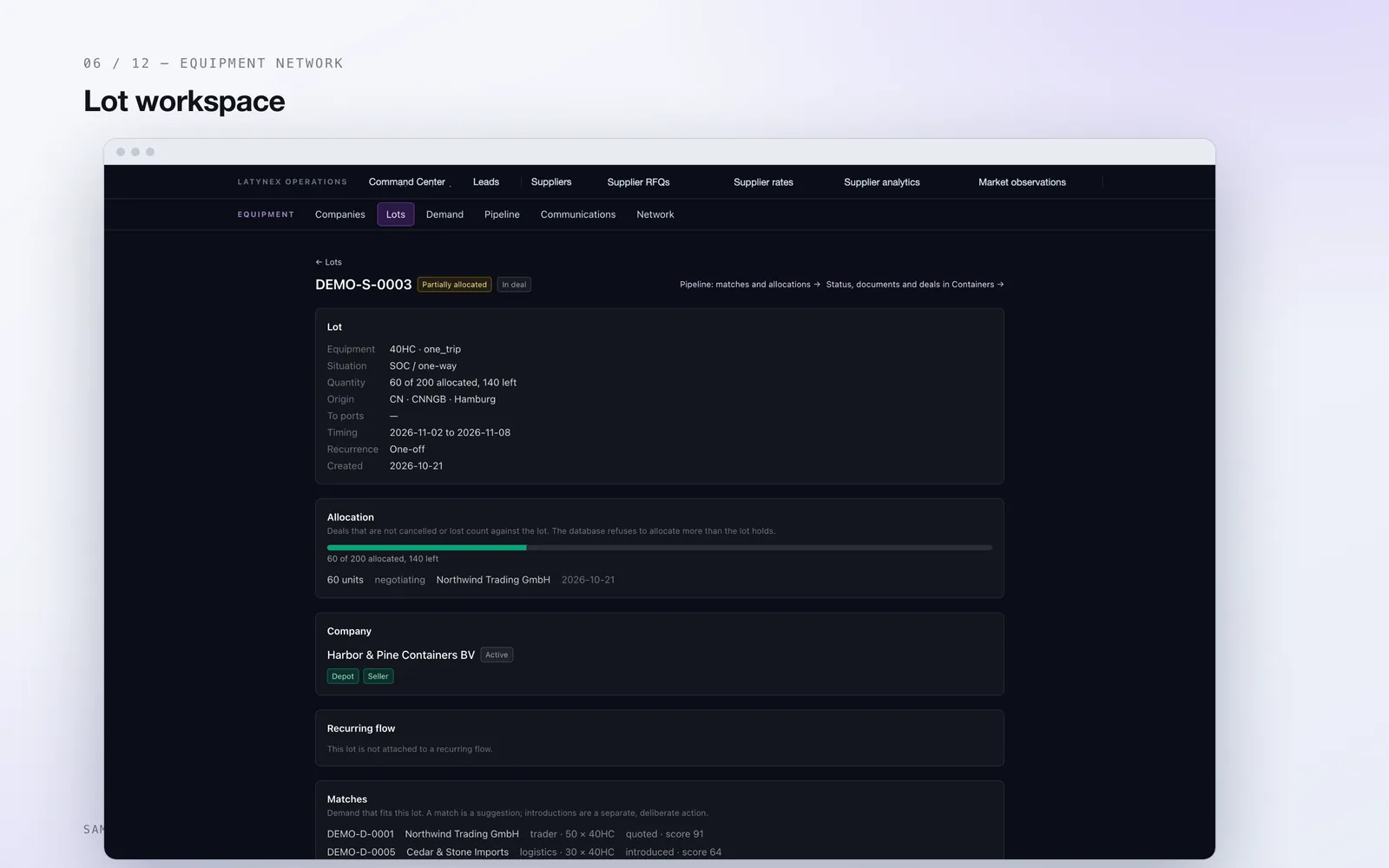
Lot list and lot workspace with allocation bar and operational fields
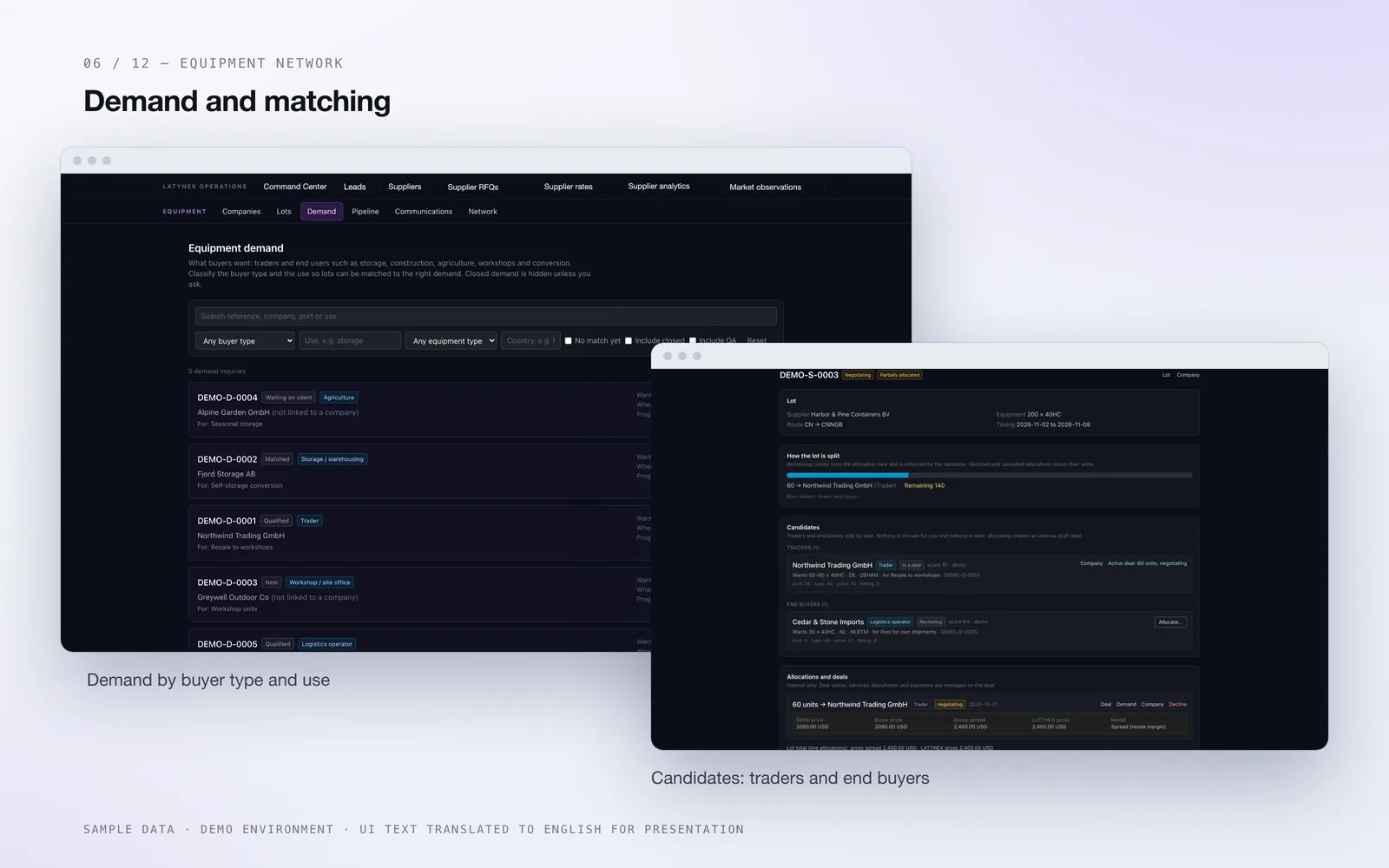
Demand list by buyer type and use
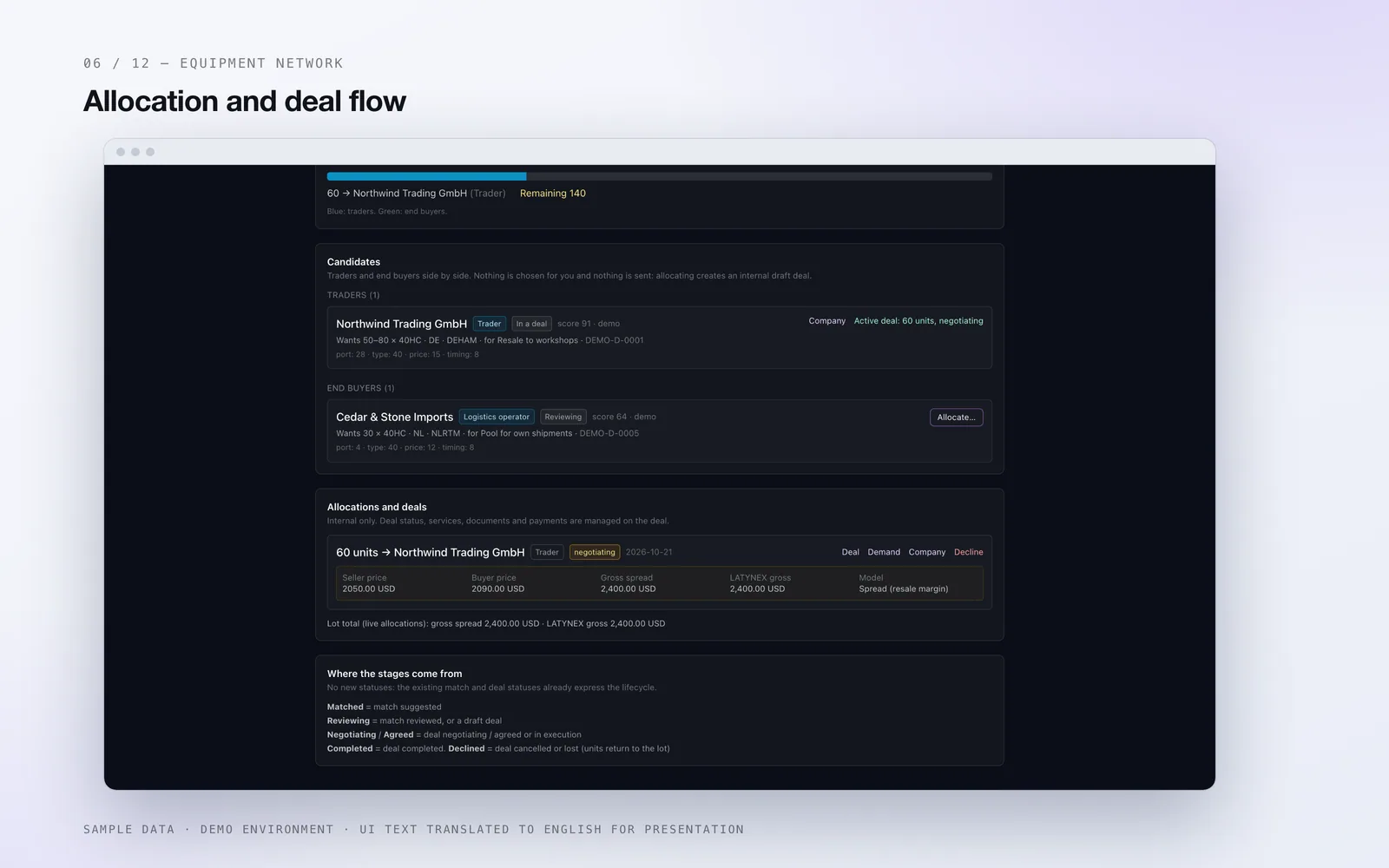
Pipeline with traders and end-buyer candidates
Part-lot allocation with oversell guard and economics preview
Deal states for compliance, payment, release and transport
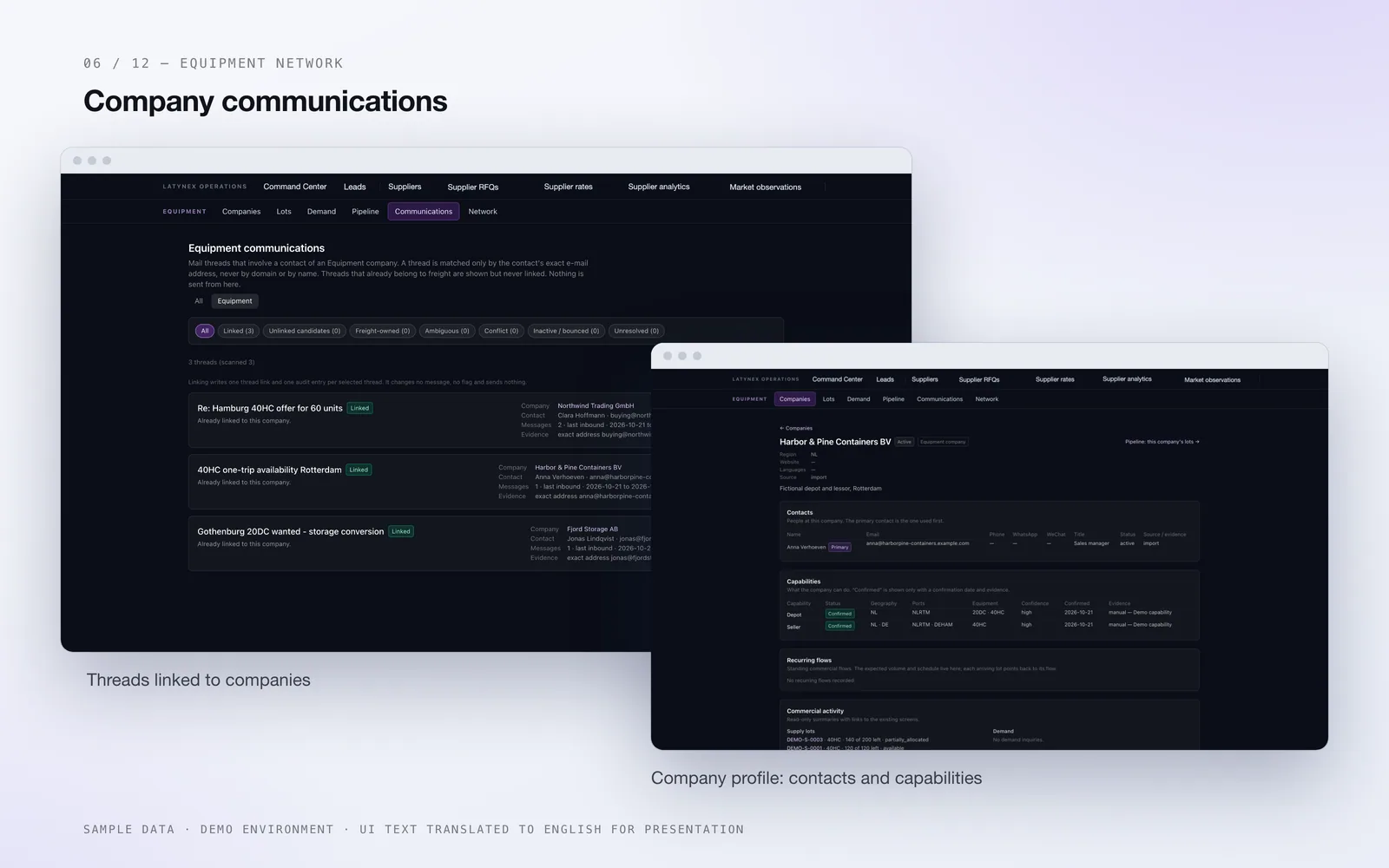
Company profiles with contacts and capabilities
Equipment communications view with exact-e-mail linking
Capabilities in the code
Match scoring with breakdown
Database-enforced allocation limits
Confidentiality tests for counterparty projections
Audited link writes between threads and companies
Anonymised private feed and alerts (implemented in code)
Product showcase
The product, screen by screen
Lot workspaceDemand and matchingCompany communicationsAllocation and deal flow
Screens come from a demo environment with synthetic data. Interface text was translated to English for presentation, so these are localised composites, not untouched screenshots.
How it works
From input to outcome
01
Record supply and demand
Supply is recorded as lots with stage, origin, timing and mandate; demand is recorded by buyer type and use case.
02
Match
The system scores matches and presents trader and end-buyer candidates.
03
Allocate safely
An operator allocates part of a lot to a buyer with an internal economics preview; a database-enforced guard prevents allocating more than the lot holds.
04
Carry the deal
Deals carry compliance, payment, release and transport states, and mail threads link to companies only by exact e-mail address.
Technical approach
How it is engineered
A module of an internal operations application: Next.js 16, React 19 and TypeScript on PostgreSQL, extended by migrations that add lots, demand, matches, deals, company capabilities and network tables, with unit, integration and confidentiality tests.
Next.js 16
React 19
TypeScript
PostgreSQL
SQL migrations
Vitest
Status and limits
What this page does and does not claim
An in-house product shown on a demo instance. It is not a public marketplace and is not described as live in production.
There is no public URL. All companies and lots shown are fictional.
No transaction volumes, deal values or revenue are claimed.
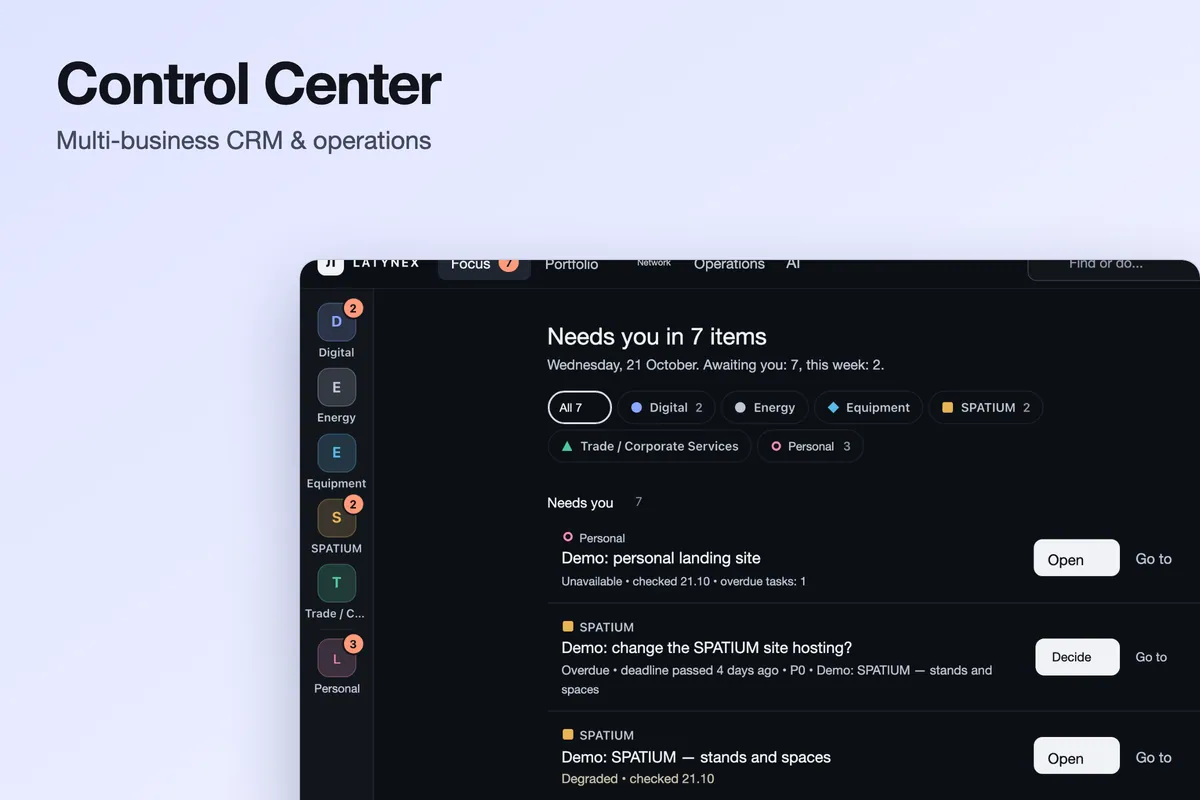
A multi-module operations platform that gives one owner a single focus queue, decisions, tasks, portfolio and lead inbox across several business directions.
Focus queue, decisions and unified tasks
Portfolio and lead inbox across modules
Operation registry for people and AI-agent actors
In-house product — not external client workView case study →
Need something like Equipment Network?
Tell us what is not working today. You get a straight answer on what it would take, and whether we are the right team to do it.