A multi-seller warehouse must prove who owns and who holds every unit, process orders against deadlines and bill sellers accurately, without the ambiguity that spreadsheets create.
Solution
What LATYNEX Digital built
A ledger-based platform where stock, custody, audit and billing derive from the same recorded events, with role-based office tools, a seller portal and device clients.
What it demonstrates
What this shows we can build
A ledger-based platform in which stock, custody, audit and billing derive from the same recorded events, with office tools, a seller portal and scanner clients.
Controls in the data layer: an append-only stock movement ledger, a hash-chained audit log and row-level security on tenant tables.
How the same capability could serve another business
A business that has to account for stock, orders and several parties could build on the same event-ledger approach for inventory, orders and billing.
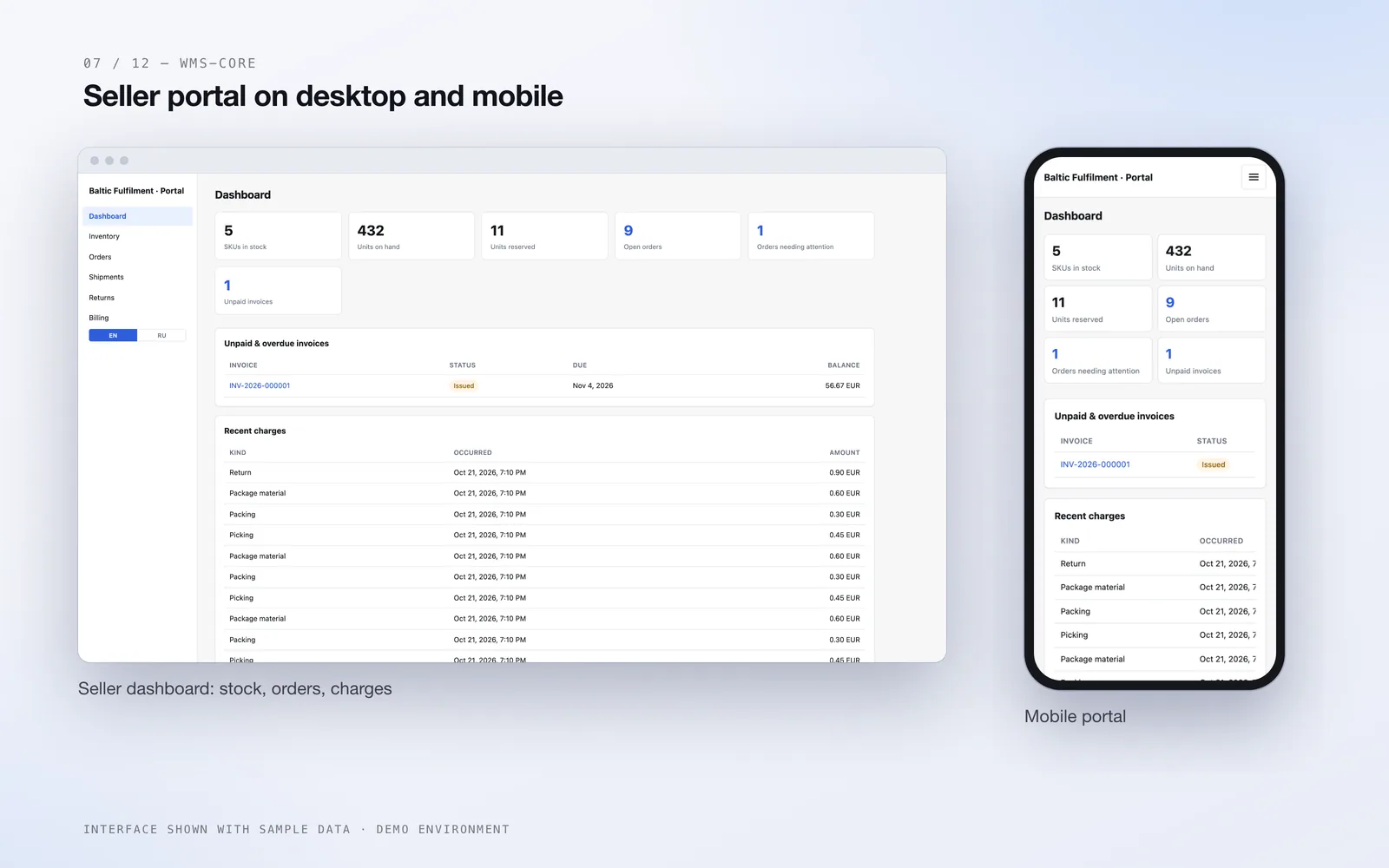
Seller portal with stock, orders, invoices and charges
Tariffs, billable events and invoices
Marketplace order-feed adapters (in code)
Expo scanner client (code)
Capabilities in the code
Append-only stock movement ledger
Hash-chained audit log
Row-level security on tenant tables
Office roles, device tokens and seller sessions
English and Russian interface
Migration runner with 47 SQL migrations
Product showcase
The product, screen by screen
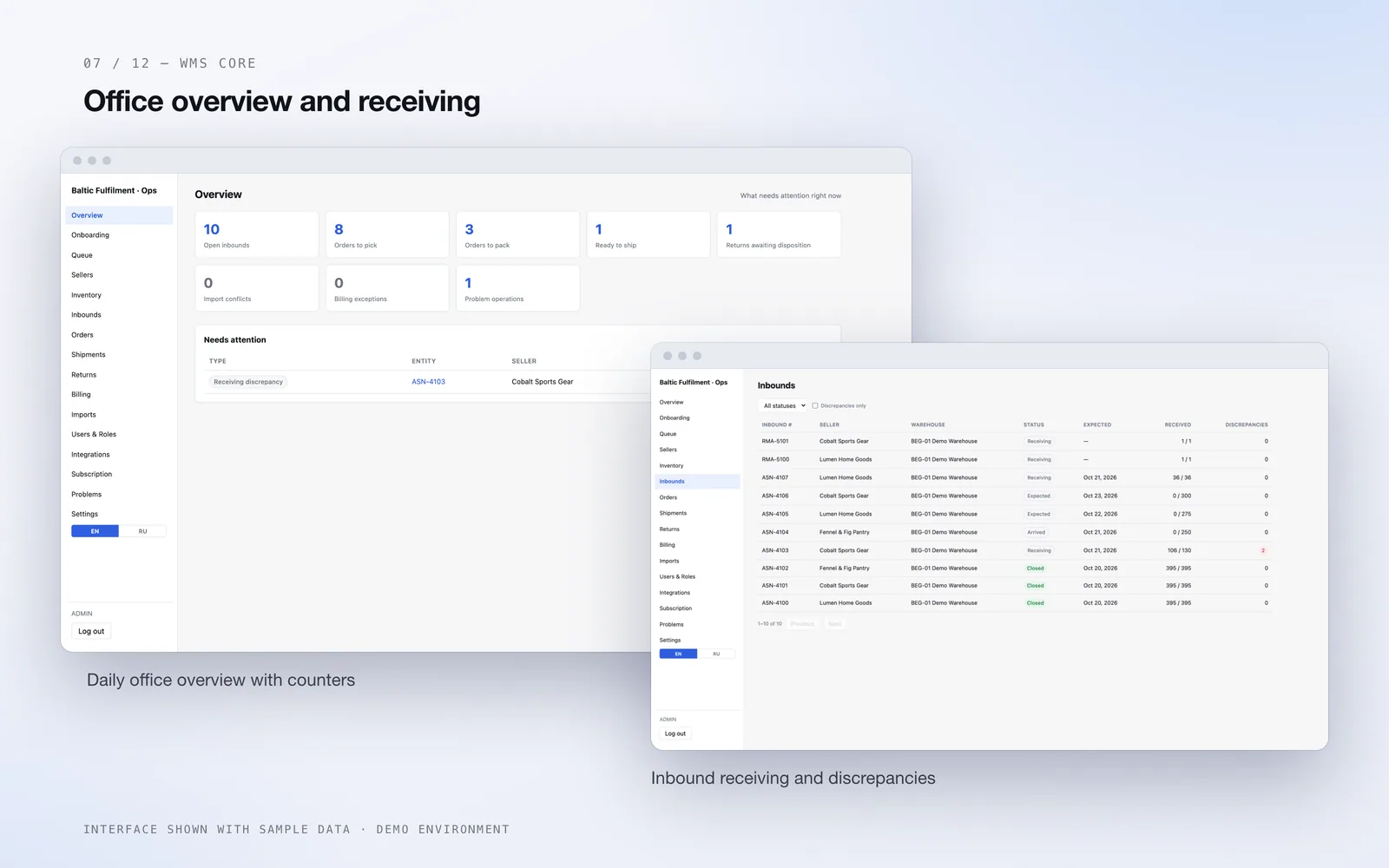
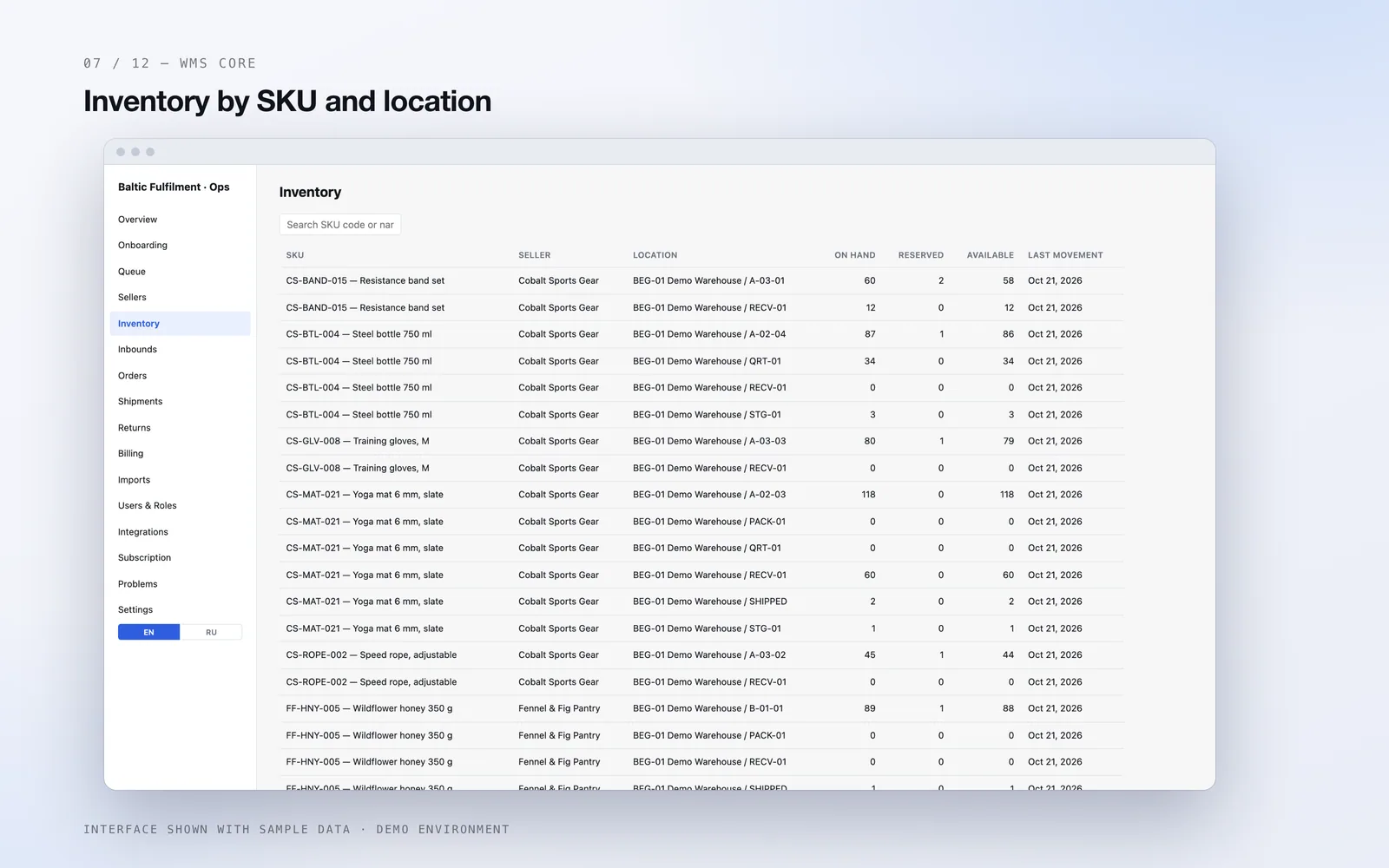
Office overview and receivingOrder queue with SLA priorityInventory by SKU and locationSeller portal on desktop and mobile
Interface shown with sample data in a demo environment. The shell title uses a sample tenant name.
How it works
From input to outcome
01
Every movement is recorded
Receiving, putaway, picking, packing, shipping and returns all write to an append-only stock movement ledger.
02
Balances come from the ledger
Stock balances are derived from recorded events; ownership is kept separate from custody, and discrepancies carry responsible-party attribution.
03
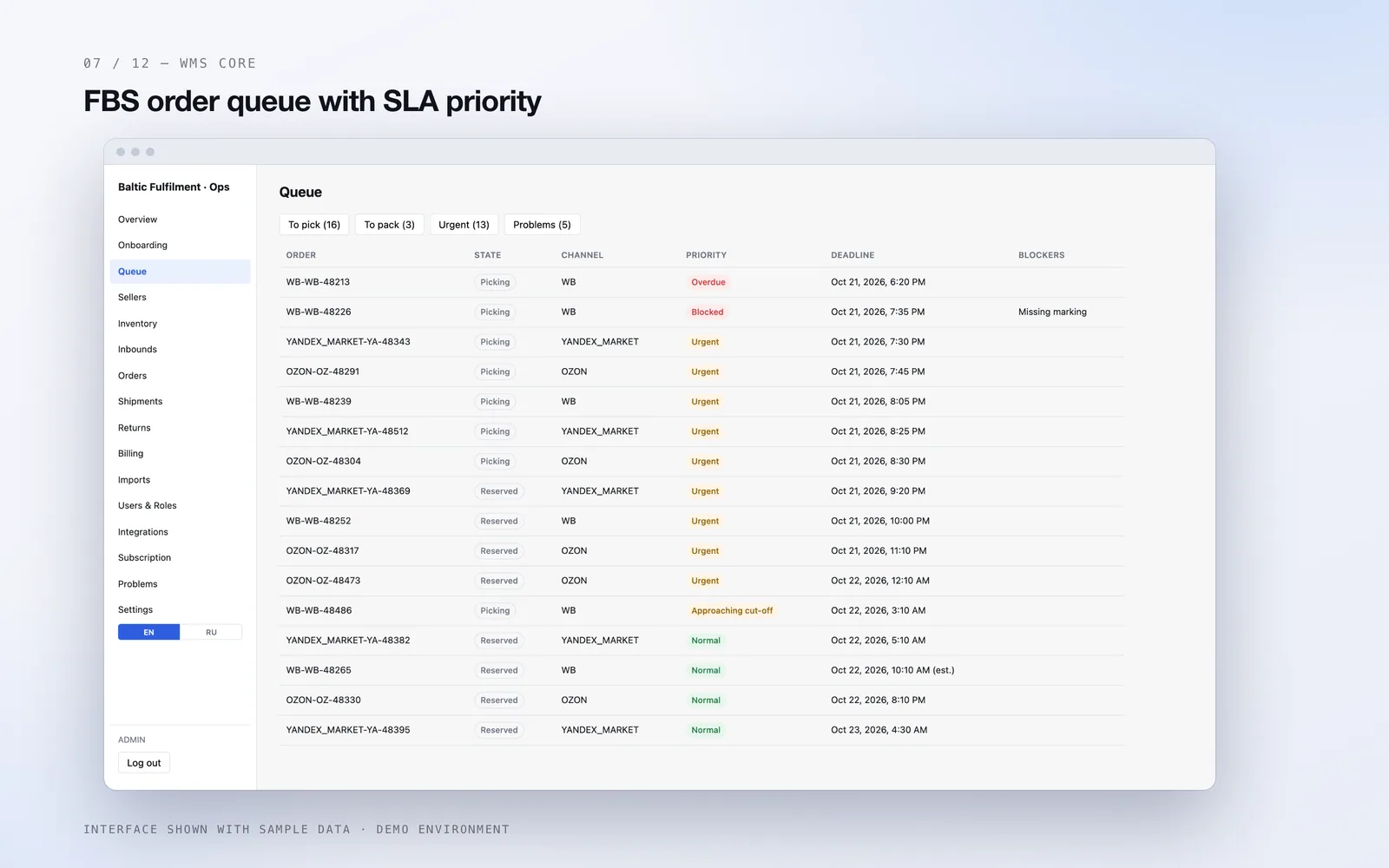
Orders are ranked by deadline
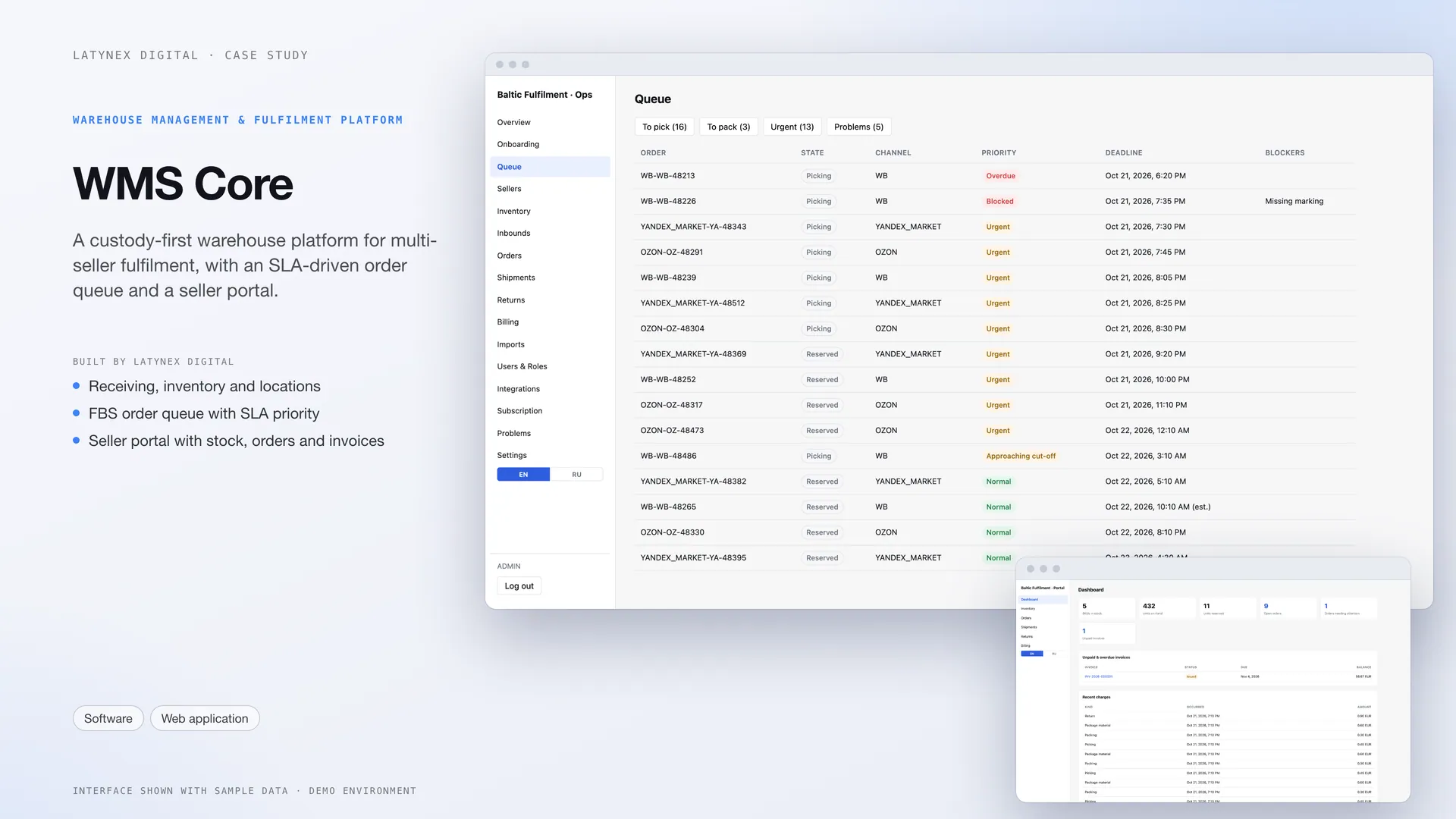
The office application ranks orders by SLA and cut-off, with blockers such as missing marking.
04
Sellers see their own data
A seller portal shows stock, open orders, invoices and charges; billing covers tariffs, billable events and invoices.
Technical approach
How it is engineered
A TypeScript monorepo: a Hono API on Node, PostgreSQL with row-level security and monthly partitioned ledgers, Vite and React single-page apps for the office and the seller portal, and an Expo app for scanners. Unit, integration and browser test suites accompany it.
TypeScript
Hono
PostgreSQL
React
Vite
Expo / React Native
Playwright
Status and limits
What this page does and does not claim
This foundation has not yet been deployed at a customer warehouse.
It is a configurable software foundation, not a turnkey SaaS product.
Shown on a synthetic demo instance with the receiving-to-shipping flow driven through the real services; there is no public URL.
Marketplace order-feed adapters exist in code; their live behaviour has not been validated.