Direct answer
This isn't the intake step itself — see Car Rental Lead Automation for how a rental enquiry actually gets qualified (dates, vehicle class, cross-border, insurance and the rest). This is what happens after that: the enquiry is logged with a real status, followed up automatically if it goes quiet, and handed to your team specifically for the two things that always need a person — confirming real vehicle availability and the final price.
An enquiry's actual status, tracked automatically
A rental enquiry moves through a real sequence whether or not anything currently tracks it: a new enquiry needs a few missing details, then it's ready for your team to check availability and quote, then it's waiting on the customer to confirm, then it's a confirmed booking or it's lost. A typical sequence:
Example sequence
New Enquiry → Needs Info → Ready to Quote → Waiting on Customer → Confirmed / Lost.
What moves on its own
- The enquiry is acknowledged the moment it arrives, day or night
- Missing details are asked for automatically — the qualification step itself, unchanged from how it already works
- The enquiry's status updates as new information comes in, instead of living only in someone's head
- Your CRM or booking log is updated to reflect the current status — not just your inbox or WhatsApp thread
- A follow-up goes out automatically if a customer goes quiet after being asked to confirm
- A reminder is created for your team if an enquiry has been sitting in "ready to quote" too long
What always waits for your team
Confirming that a vehicle is actually available for the requested dates, and confirming the final price — including any seasonal, cross-border or deposit adjustments. Neither of these is automated, and neither is presented as automated. The system prepares everything needed to make that call quickly; it does not make the call.
A real workflow, broken down
Not a mockup — a real completed enquiry from an actual car rental installation, and exactly where automation ends and a person takes over.
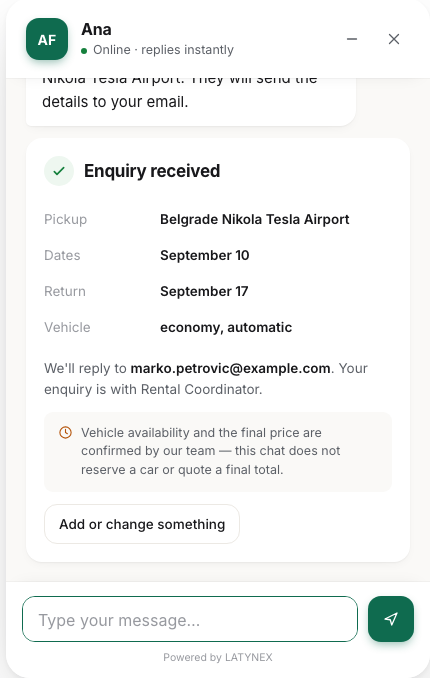
Real workflow: a rental enquiry, from first message to handoff
Input — what actually arrives: a message asking about renting a car, usually with only some of what's needed (dates, or a vehicle preference, rarely everything at once).
What the system understands
The missing pieces get asked for and structured: pickup and drop-off, dates, vehicle class, driver details, cross-border, insurance, deposit, add-ons and budget — this is the part visible in the image below.
What requires approval
Real vehicle availability for those dates, and the final price — both explicitly confirmed by the rental team, never by the AI. This boundary is stated on the completed brief itself, not just in this page's copy.
What the operator sees
The structured brief shown below — not a raw chat transcript. This is the actual artifact a manager receives.
What gets updated and logged (the operational layer this page adds)
Once the brief exists, the enquiry's status is tracked — new, needs info, ready to quote, waiting on the customer, confirmed or lost — and a follow-up goes out automatically if the customer goes quiet. That status tracking and follow-up isn't part of the image below; it's the layer built on top of the intake shown here, described earlier on this page.
What this does not do
It does not check, display or claim live vehicle availability — there's no booking-engine integration behind it, and none is implied. It does not calculate or quote a final price automatically — no pricing logic runs behind this. It does not complete a booking. These are deliberate boundaries, not gaps waiting to be filled by a future version.
How this fits with the underlying qualification
This builds directly on the same intake system described in Car Rental Lead Automation — nothing about how an enquiry is qualified changes. What's new is what happens once qualification is done: the status tracking, the CRM/OPS update, the automatic follow-up, and the clear handoff point for availability and price. See AI Operations Automation for how this same status-tracking-and-handoff pattern applies outside car rental too.
Setup and pricing
The qualification step itself follows the plans described on Car Rental Lead Automation. The operational layer on top — status tracking, CRM/OPS sync, automatic follow-up — is scoped and priced as part of a setup-plus-managed-service engagement, since it depends on which system you already log bookings in and how your team currently tracks a rental request. See Pricing for how LATYNEX prices engagements generally, and the Free Revenue Audit as the starting point for a specific number.
Questions
Does this check real vehicle availability?+
No — there's no booking-engine integration behind it. It tracks the enquiry's status and hands it to your team at exactly the point availability needs checking.
Does this quote a price automatically?+
No — final pricing, including seasonal or cross-border adjustments, is always confirmed by your team, not calculated by the system.
Is this a different product from Car Rental Lead Automation?+
No — it's the same intake system, plus what happens to the enquiry after qualification: status tracking, CRM/OPS updates and automatic follow-up.
What happens if a customer goes quiet after being asked to confirm?+
An automatic follow-up goes out rather than the enquiry silently going cold, and your team is flagged if it's been sitting too long with no response.
Does this work for a multi-branch rental business?+
The status-tracking pattern works per enquiry regardless of branch count — the specific handoff and CRM/OPS setup is scoped to how your business currently operates across branches.